
Forward
I was fortunate to be in Barrow, Alaska, on assignment a few years ago, photographing the then brand new Samuel Simmonds Memorial Hospital. Barrow sits roughly 330 miles north of the Arctic Circle and about 1,300 miles from the North Pole.
Over the course of photographing the hospital, I learned that the semiannual whale hunt was scheduled to take place just a few days later. Although I was unsure whether I would be welcome to photograph the event, everyone I spoke with expressed excitement about the hunt and assured me that visitors were welcome.

Utqiagvik, Alaska | Search and Rescue Station
The previous season’s hunt had been difficult. Wind-driven sea ice pressed against the shoreline, largely preventing crews from getting their boats into the water. Only two whales were taken. One of them—a 44-foot “stink whale”—was lost for six days and recovered only after it resurfaced. By then it was rancid, though portions of the animal were still salvageable.
I arrived at Search and Rescue just a few hours after the first boats went out for the opening hunt of the season. Other crews gathered inside, listening to the radios and waiting. No one spoke much.
This year, they did not have to wait long for good news.

Hunter
A crowd gathers along the beach as the returning vessels appear on the horizon. Engines idle low as the lead boat approaches, towing something large and unseen beneath the surface. The rope behind it stays tight, vibrating with the pull. Whale.
The pilot eases the animal—a bowhead—toward shore, the hull rising and falling with the swell, then cuts the engines. The sudden quiet is broken only by water slapping against fiberglass and the wind moving across the sea. From his perch atop the slowly rocking vessel, the boat’s captain looks on, steady and silent.

Too Many Horses
During the winter months, the work of harvesting whales takes place out on the ice, done largely by hand using ropes, hooks, and pulleys. It is both labor and ritual—a celebration thousands of years old—guided by a precise, step-by-step choreography handed down through generations.
The climate is warming. This year, there is no sea ice. In its absence, the work shifts onto land, where heavy machinery now waits on the frozen beach. A new set of ropes is attached, and the carcass is slowly dragged from the sea to shore, the engines and winches replacing much of the manual effort once required. The rhythm and pace of the hunt are transformed, yet the work remains a careful, communal process that balances tradition with the demands of a changing landscape.

Cortege of a Bowhead
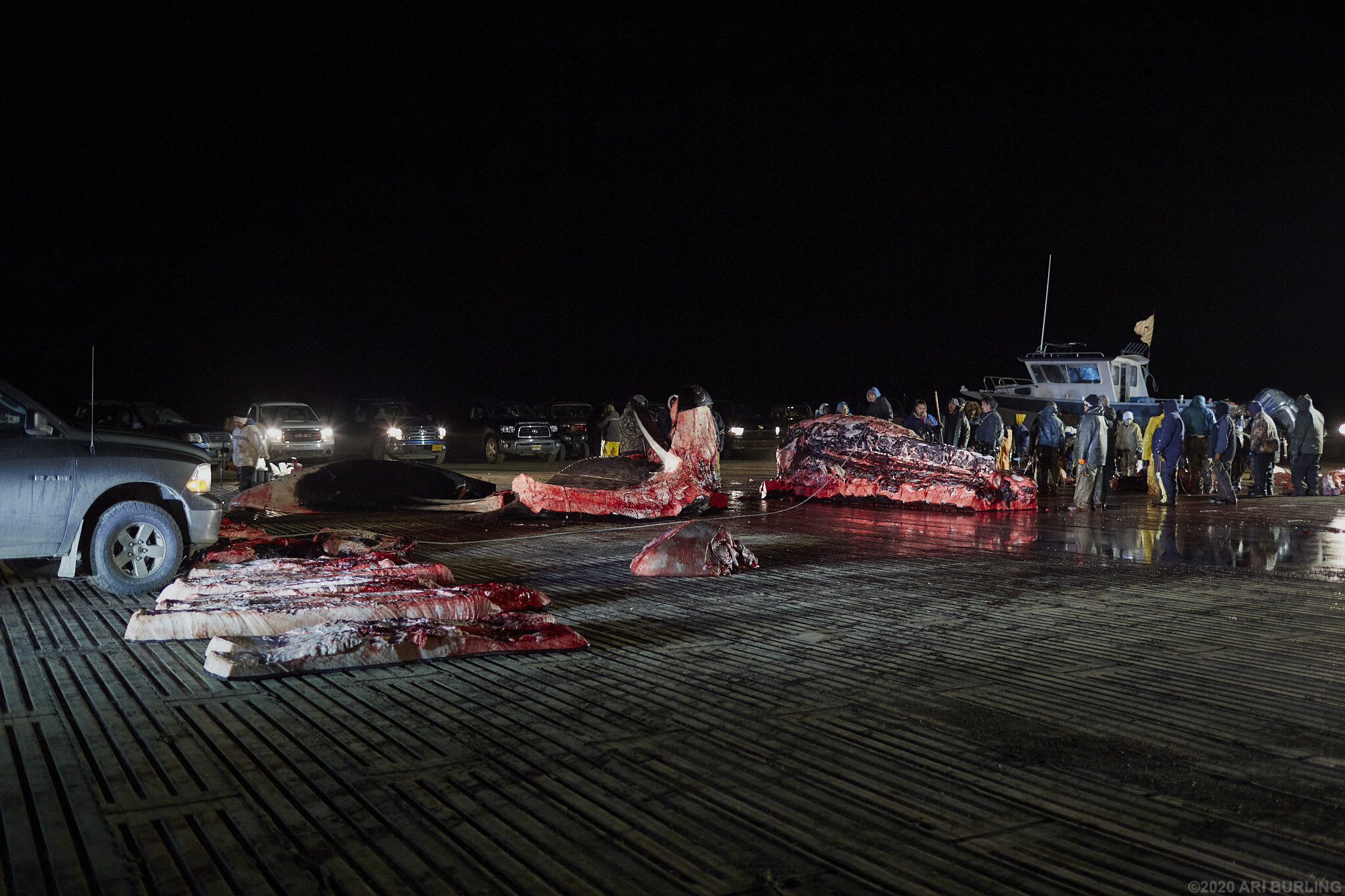
Two Volvo wheel loaders are used to move the heavy whale from the beach to the corrugated tarmac, a repurposed section of an old runway. The weight of the mature bowhead exceeds their lifting capacity, and the tractor carrying most of the load tilts its rear wheels into the air, swinging slowly back and forth as the two machines move forward in tandem. Behind them, the village follows—on foot and in trucks—in what feels like a solemn procession.

The Temperature of an Iris
A group of scientists is present, observing by mutual agreement during the whale hunt to study bowhead whales up close. Carefully, they extract a small sample from the whale’s eye using precise instruments. By analyzing the amino acids within, they will determine the animal’s age—a measurement that can reveal centuries of life. Bowheads can live up to 200 years; an elder whale could have been alive at the same time as Abraham Lincoln.
In this way, the hunt provides a rare intersection of tradition and science, offering a measured view into the enduring life of one of the ocean’s oldest creatures.

Handprint
The whale lies on its back, baleen shimmering in the steady winds rolling off the Chukchi Sea. Cloud cover shifts in shades of blue and gray. On its side is the imprint of a human hand, resembling a hieroglyphic.
Children climb and play on the inert whale, while parents take photographs, capturing the moment.

Sisters
Two sisters approach, curious about the man with the camera and the many photographs he is taking. They explain that a photographer visited the year before and used the images in an anti-whaling campaign with Greenpeace. According to the sisters, that portrayal was unfair, and they are wary of being misrepresented.
I introduce myself. “No, I don’t work for Greenpeace,” I say, and they relax, smiling. They ask why I am taking so many pictures. I tell them I have no reason other than my curiosity and simply add, “Thank you.” It feels like an honor to be allowed to witness this.

Entry Wound
I consider the food I eat. It is sealed, packaged, and purchased at the supermarket. There is no evidence of its origin—no trauma, no process—only the final product. Convenience, mass consumption, and profit determine its form.
To kill a whale, a small explosive charge is attached to a harpoon. The detonation kills the animal instantly.

The Work Begins
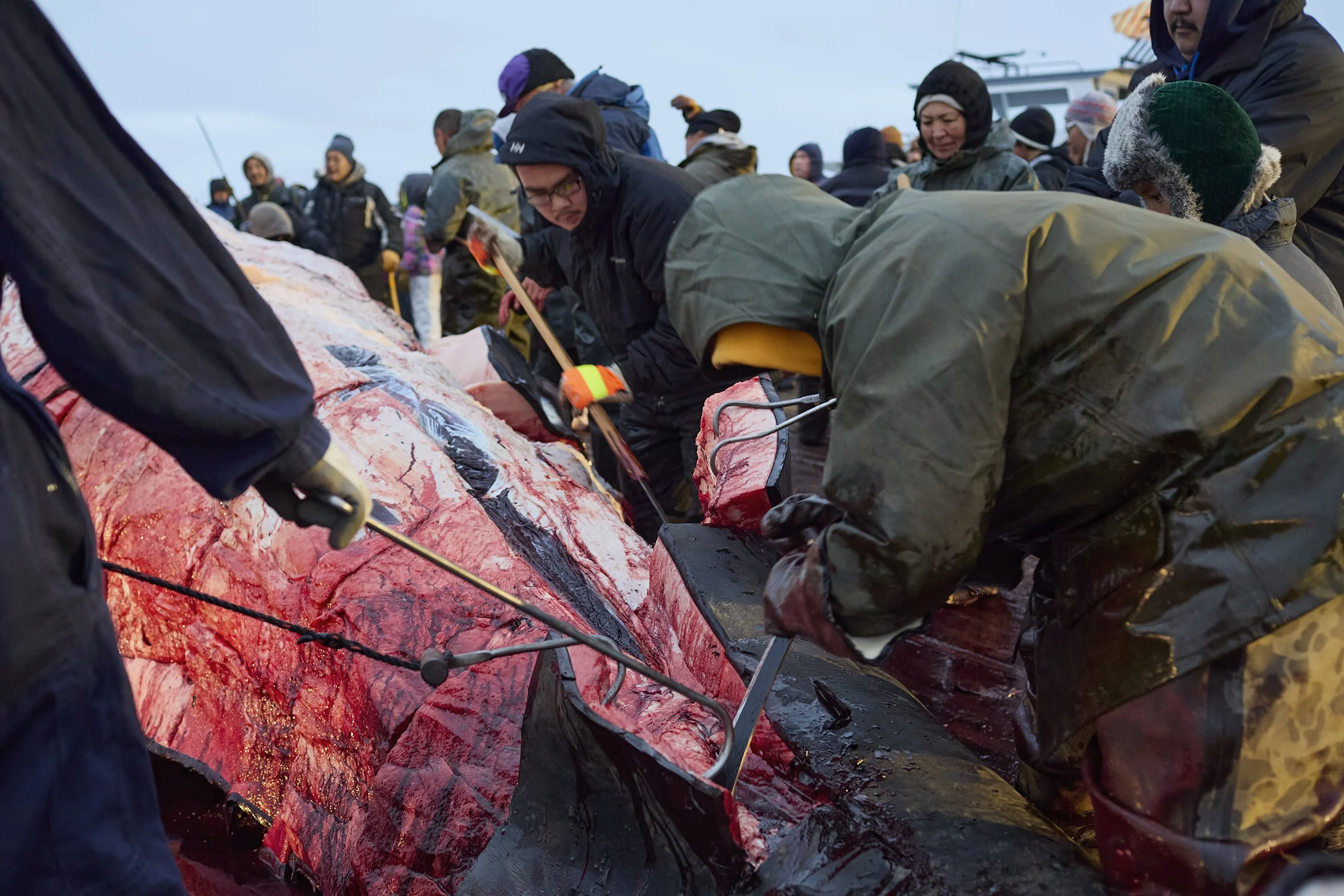
The hunters return, and the work begins. A long horizontal cut is made down the length of the animal, accompanied by vertical cuts about 18 inches apart through the outer layer of blubber. Pieces are sheared off and pulled away by young men. The sound of tearing flesh is punctuated by heavy thuds as each piece strikes the ground.

A Village
Taking a whale apart is a lengthy process. The sisters tell me they hope to catch many whales today. It is messy work done with practiced efficiency.
Clearly evident is the orchestrated collaboration. Community.

Nightfall
Contemporary whaling is subject to intense debate. There is commercial whaling, and there is subsistence whaling. International bans restrict commercial whaling, though these rules are not always observed.
A subsistence economy is a non-monetary system that relies on natural resources to meet basic needs through hunting, gathering, and small-scale agriculture. “Subsistence” refers to supporting oneself at a minimum level; in such an economy, economic surplus is minimal and typically used only to trade for essential goods.

The Hunt Is Life
The following day, I visit my new friend Eunice. We sit on the floor, and she lays down a piece of cardboard before cutting the whale meat into smaller portions for storage.
While we talk, her granddaughter—unbeknownst to us—leaves a trail of oily footprints and handprints across the house, tracking whale oil from her socks and pajamas.
Eunice takes a slow breath, glances at her granddaughter dressed in purple, and moves to the cabinet for cleaning supplies. After yesterday’s exhausting labor of harvesting whales, the house now requires attention. She mutters something under her breath in a tone any parent would recognize.
The room is quiet for a moment, the day’s work lingering in the air. Looking back at me, she declares, “The hunt is life.”